ICL and IPCL surgery in Delhi
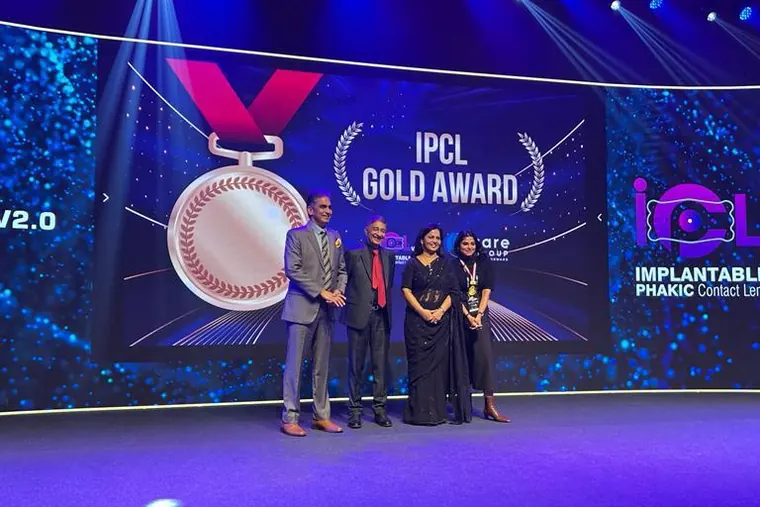
An implantable lens for high glasses power, thin corneas and eyes that are not ideal for LASIK. I hold the Gold Medal for the highest number of IPCL surgeries performed in the North Region.

The lens
What is an ICL or IPCL?
An implantable collamer lens (ICL) or implantable phakic contact lens (IPCL) is a thin, flexible lens placed inside the eye, between the coloured iris and your own natural lens. Think of it as a contact lens that stays in place permanently, without ever touching the surface of the eye. No corneal tissue is removed, and your natural lens stays.
- Corrects high short sight, and astigmatism with toric lenses
- Does not thin or reshape the cornea
- Can be removed or exchanged if ever needed
- Gold Medal for the highest number of IPCL surgeries in the North Region
Suitability
Who is ICL / IPCL for?
An implantable lens is often the safest route to clear vision without glasses when laser surgery is not the right fit.
High glasses power
Power beyond what laser surgery can safely correct for your cornea.
Thin or irregular cornea
When there isn't enough corneal tissue for LASIK, the lens corrects vision without removing any.
Dry or sensitive eyes
No corneal flap is made, so it is often preferred for eyes that tend to be dry.
Adults with stable power
Usually between about 21 and 45 years, with power that has stayed steady.
Enough space inside the eye
The front chamber of the eye must be deep enough, and the corneal lining cells healthy.
No conflicting eye disease
Conditions such as glaucoma, uveitis or cataract are checked for first.
Compare
ICL / IPCL or LASIK?
| ICL / IPCL | LASIK | |
|---|---|---|
| How it works | A lens is placed inside the eye | The cornea is reshaped with a laser |
| Best suited to | High power, thin corneas, dry eyes | Mild to moderate power with a healthy cornea |
| Corneal tissue | None removed | A small amount reshaped |
| Reversible | Yes, the lens can be removed or exchanged | No |
| Surgery | About 15 to 20 minutes per eye | About 10 to 15 minutes for both eyes |
| Long-term care | Regular check-ups of eye pressure and the natural lens | Routine eye check-ups |
Read the full guide: LASIK vs ICL, which one is right for you? Or see LASIK at Netram.
Before surgery
Your ICL / IPCL evaluation
Precise measurements decide whether a lens is safe and which size and power you need.
Glasses power
An accurate refraction, repeated with dilating drops, so the lens power is exact.
Space inside the eye
Scans measure the depth of the front chamber and the eye's width to choose the right lens size.
Corneal lining cells
Specular microscopy counts the endothelial cells that keep the cornea clear.
Pressure and retina
Eye pressure and a dilated retina check, then a recommendation and a written estimate.
On the day and after
Surgery and recovery
- On the day: numbing drops, a tiny self-sealing opening, and about 15 to 20 minutes per eye. You go home the same day.
- Next day: a check of your vision and eye pressure. Vision usually improves within a day or two.
- First weeks: drops as prescribed, no rubbing, and no swimming for the advised period.
- Back to work: most people return to desk work within a few days.
- Long term: a yearly eye check to monitor eye pressure and the natural lens.
Questions
ICL / IPCL FAQs
The lens is designed to stay in your eye long term, with no maintenance. Unlike laser surgery, it can also be removed or exchanged later if ever needed.
No. The lens sits inside the eye, behind the iris, so you cannot feel it and nobody can see it.
Neither is better for everyone. ICL / IPCL usually suits higher power, thin corneas or dry eyes; LASIK suits many moderate powers with a healthy cornea. See LASIK vs ICL for a full comparison.
Both are implantable phakic lenses that sit inside the eye in front of your natural lens. They come from different manufacturers and use different lens materials and designs. IPCL lenses are made to order to each eye's measurements. I recommend the one that fits your eye best after the evaluation.
Yes. Toric versions of the lens correct astigmatism along with short sight.
The procedure takes about 15 to 20 minutes per eye under numbing drops, and you go home the same day. Vision usually improves within a day or two, and most people return to desk work within a few days.
Like any eye surgery, it can. Possible problems include raised eye pressure, inflammation, and over many years a higher chance of cataract; serious infection is rare. That is why careful sizing before surgery and regular check-ups afterwards matter.
It depends mainly on the lens type, for example toric or non-toric, and the lens chosen for your eye. You receive a written estimate after the evaluation, once the lens is selected.
Book your ICL / IPCL evaluation
Netram, E-98 Greater Kailash-2, New Delhi · 011-41046655